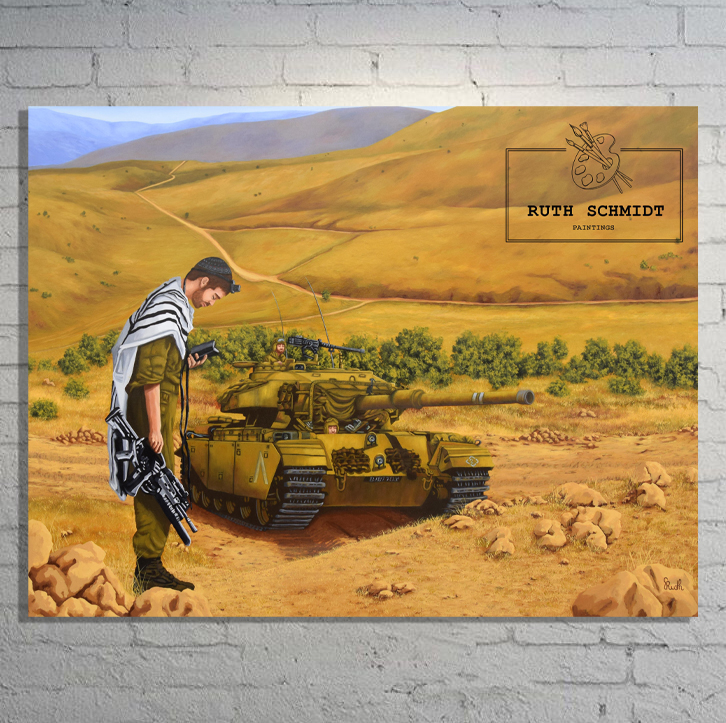
90×120 cm, oil on canvas
Michael Greenspan, a former CNN reporter and investigative journalist, once conducted an interview with Avigdor Kahalani, a former Israeli military commander. That report left a deep impression on me, and it ultimately inspired this painting—titled In Pursuit of Miracles.
The story takes us back to October 6, 1973—Yom Kippur, the Day of Atonement. According to Jewish law, all work is forbidden on this holy day, and most people were either at home or in synagogues. The entire country’s communication network was essentially inoperative.
More than 100,000 Egyptian soldiers launched a surprise attack against Israel, while at the same time, 1,000 Syrian tanks surged from the north toward the Golan Heights. Within hours, the Egyptian forces were advancing toward Jerusalem, and Syrian tanks pushed through the Golan, aiming for Tel Aviv. Within just 24 hours, Israel lost roughly two-thirds of the Golan Heights. In the early days and hours of the war, more than 1,400 Syrian tanks crossed the border and began their assault—while Israel had fewer than 200 tanks to defend itself.
If there has ever been a modern parallel to the ancient story of David and Goliath, the Yom Kippur War is certainly one.
The outcome of the war rested on the shoulders of young "Davids"—soldiers who stared death in the face without flinching. Among them was Avigdor Kahalani, a young tank commander in 1973. His unit received orders to stop the Syrian army in the Kuneitra region. Under constant fire, many of their tanks were hit. Syrian planes bombarded them, yet not a single Israeli aircraft came to their defense.
The tide of the battle for the Golan eventually turned in the struggle for a strategic hilltop known as "Little Hermon." The valley below has since been called the Valley of Tears.
Most of the Kahalani’s tanks had been hit by Syrian fire. Defeat hung in the air. He was left with just four operational, though damaged, tanks. With these, he launched a daring counterattack up the hillside. Reinforcements did not arrive. But to Kahalani’s astonishment, the Syrian forces suddenly appeared gripped by fear. The massive attacking force began to retreat. Syrian soldiers fled the battlefield in chaos.
Before the war ended, one of the most extraordinary turnarounds in modern military history had taken place. Israel pushed the Syrian army back to the gates of Damascus and nearly drove the Egyptian forces all the way to Cairo. On the Golan Heights alone, Syria lost nearly 1,000 tanks—around 900 of which were abandoned on the battlefield. U.S. support also played a crucial role in this outcome.
For his bravery in the Valley of Tears, Avigdor Kahalani was awarded the title “Hero of Israel,” the nation’s highest honor for valor in the defense of the country. Yet he humbly said only this: “It was my men who fought bravely, and it was a miracle that saved Israel.”
At the end of Greenspan’s report, the memorials of the fallen heroes are shown. “The names etched in stone, preserving the memory of these heroes, speak of courage and sacrifice. Behind each name is a soldier who gave his life to defend the miracle we now call Israel.”
And then Greenspan concludes with a question:
“Is there truly a hidden, mysterious force at work here? Could it be that the hand of God still protects this ancient land and its people today? Whether it was a miracle or something else— this is what I set out to discover.”
The work speaks about a harsh reality: in Israel, there is rarely time to “just” celebrate. Joy is always tempered by vigilance. Peace is fragile.
But isn’t just about war, the extraordinary resilience of a nation that has had to fight for its survival since its inception — but it’s about identity, resilience, and the unshakable belief that miracles do happen.