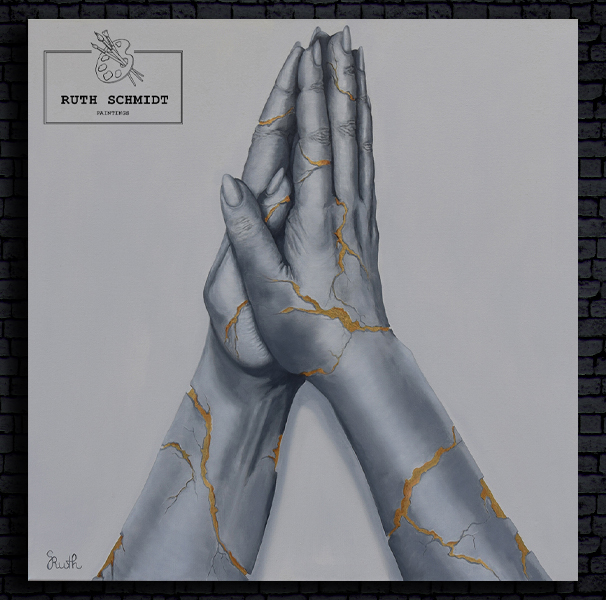
60×60 cm, oil on canvas
There are occurrences in life when all our supporting pillars are shaken and we do not understand many things. There are times when we do not understand God... why He permits things. Breaking points occur in trust, faith, and hope, but there is no other solution than to stand up and move on. Perhaps we will become stronger, perhaps also wiser... it is also possible that we will never get answers... but life goes on... „Kintsugi is the Japanese art of putting broken ceramic pieces back together with gold. By embracing flaws and imperfections, more beautiful works of art can be created.".
In today's world, we are used to everyone striving for perfection, or the appearance of it. We feel the same way about objects: what is broken is either thrown away and replaced with a new one, or we try to repair it in a way that hides the flaw. We perceive damage as something negative and try to conceal it. In Japan, however, there is an art form that focuses on the exact opposite. This is kintsugi. According to kintsugi, every break is unique, and instead of repairing the ceramics to look brand new and flawless, the 400-year-old technique actually focuses on highlighting the „scars.” It serves as a reminder of impermanence, that anything can break or get damaged, yet it can still be beautiful, and once repaired, it will be stronger at the fracture points. This is also a wonderful metaphor for healing and recovering from hardships. According to one theory, kintsugi appeared in the late 15th century when Japanese shogun Ashikaga Yoshimasa sent one of his favorite broken Chinese tea bowls back to China for repair. However, the Chinese masters repaired it with ugly metal staples, which did not please the shogun, so he challenged Japanese artisans to find a different, more aesthetic repair method. Thus kintsugi was born, which well represented Japanese aesthetics and worldview, manifested in acceptance, impermanence, and imperfection—Tünde Sebők perfectly captured the essence of kintsugi.